
Discovery Exploration
An attempt at making finding the X more interesting...

Welcome to the Glyph and Grok - A weekly blog-letter exploring design, execution, and culture relating to anything played on a tabletop. See the other pieces on Game Mastering from the Glyph and Grok here.
Introduction
Good day dear reader! This last week I got the chance to host a live game for five friends in my Catastros setting for what is becoming a Shadowdark hack. Across a six hour play session, we got to test an exploration discovery system I’ve been working on and the party wrecked a group of goblins, and then delved the first floor of the dungeon they found.
There are a lot of converging ideas coming together in this game. The adventure prep, the world setting, and rules/system ideas I subjected my players to are all intended to meaningfully lay groundwork for club style community play to grow in the future.
This week we are going to walk through how it went from my perspective and see what insights there are to glean from this play session.
The Thing
The adventure site I prepared is none other than the “The Forgotten Abbey of the Moth-Goddess” the title that was voted for by the readership of the Glyph and Grok and expanded upon in these previous posts: Adventure Pt. 1, Forgotten Abbey of the Moth Goddess Pt. 1, Forgotten Abbey of the Moth Goddess Pt. 2
The abbey map design is large at 24 rooms, so the location is intended to be an “adventure site” which would typically see multiple visits from adventurers before it would be cleared out - if it can be cleared out.
I had sketched ideas for all areas of the dungeon, but I focused on the first floor and the first area of the second floor to keep to what could be explored in a one-shot that would include the players needing to find the entrance in the first place.
The idea of having to find the entrance at first glance breaks a common piece of advice given to gamemasters, which is to start where the action is - don’t make your players find the game, get them into the action immediately. While I know this, I am looking to make a trade off in this regard with intent. I was looking for an answer to “Is it possible to make it interesting, and hopefully fun, to have a probability to getting lost trying to find the X on a treasure map?”
One of my goals with this setting is to create a smattering of situations of various types to have constantly on offer for the players to choose from. And I want one of these situations to be finding a treasure map and looking for a specific place to come back with treasure from.
I’m hoping to make part of “the action” be discovery exploration.
The system the party tried out for me started with the players having a blank sub-hex map with a token for their location. This represented a zoom-in of an atlas hex that they would be scouring to find the Forgotten Abbey. Atlas hexes are 10 kilometers across, while the zoomed-in sub-hex maps were made up of 61, 1.11 kilometer wide hexes.
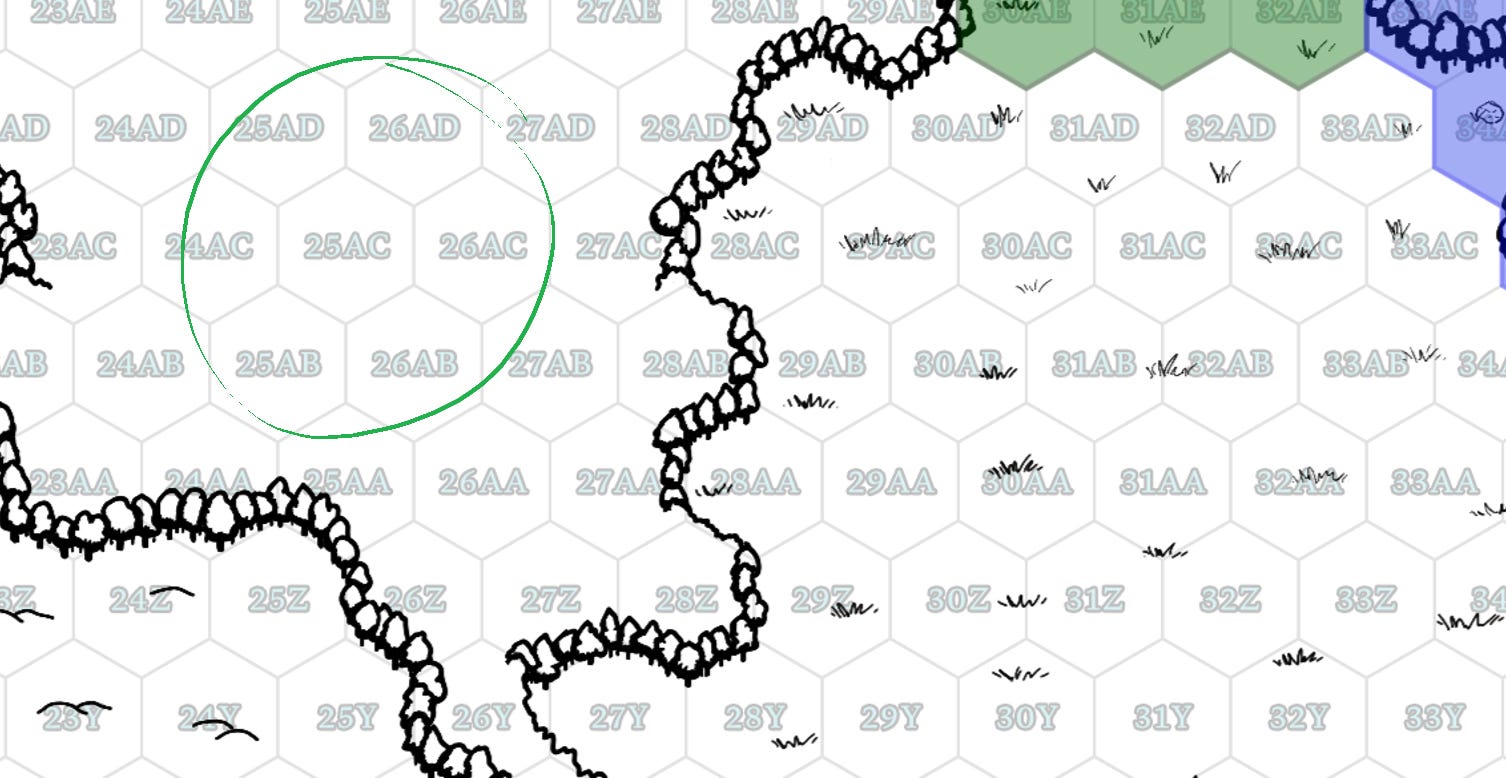
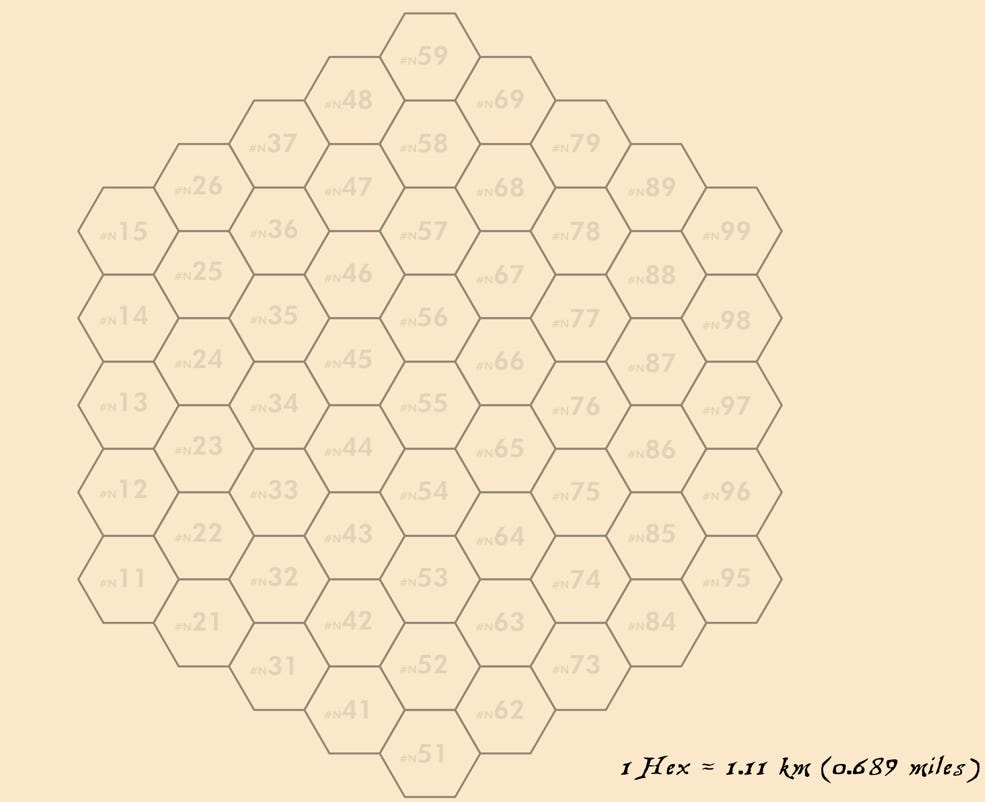
The base movement while searching the smaller sub hexes was 1 hour per hex. Traveling at the atlas-hex level was base 4 hexes (40 km or 24.5 miles) per day. It would take more time for more difficult terrain and vise-versa.
The GM, me, had a matching blank sub-hex map and I would mark the actual location the party was in with a token and what the actual biome mapping looked like. If our maps diverged, it meant the party had become lost at some point. So how would we determine if the party had found the Abbey and/or how if they’d gotten lost?
I told the party to choose a cartographer and navigator and informed they’d want party members with the highest intelligence and wisdom respectively as there would be rolling involved. Based on how difficult I figured the situation should be to navigate and map a specific sub-hex, I set DCs for the chosen cartographer and navigator to roll their INT and WIS against.
The results would either be two passes, 1 pass, or two failures.
For two passes, they would be informed of exactly what sub-hex they were on - meaning if they were lost they’d suddenly discover that fact and we’d fix their maps to be like the GM’s map and move their representative token to the actual sub-hex they were on.
For one pass, they’d move in the direction they’d intended to go.
For two failures, they would be moved in a random direction on the GM’s map, but be told to move in their intended direction on the player’s map. Something that helped mask this, was that anytime the players entered a hex that was blank without a biome type yet, the GM would roll 2D6 to get a result from a forest sub-hex type table. This roll could double as a random direction result, and if either of the dice had a 1 showing, the GM could then roll for a forest hazard and/or random encounter.
Finally to randomly determine where the Forgotten Abbey actually would be found, I used a favorite mechanic here at the Glyph and Grok, a diminishing pool. Starting with 10D6 in the pool, each time the party made significant progress towards the direction I figured the Abbey should be, they rolled two successes, or they did something clever in regards to finding it, I rolled the diminishing pool and removed any result of 5 or 6 from the pool.
In summation, we spent hours at the table playing through the party getting the treasure map and a cluster of atlas hexes rumored to house the forgotten abbey, leaving out into the wild, and exploring the forest before finding the entrance.
Of course there was a plot twist at this point, the players had not been informed that Oxblood Axehandle goblins had previously found the abbey and were delving it for loot, with an encampment setup outside the entrance….
In Conclusion
From behind the GMs screen, I enjoyed this back and forth and it felt like I got to discover what was in these areas of the forest along with my players. It also felt like the trade off was getting the intended results - The players had to spend time thinking and discussing the area as it was being mapped out and the discussion was more interesting than in games where there was a world map but nothing really happens when traveling between points on that map.
I’m sure it’s not for everybody and it’s possibly the players were bored with parts of it, but it felt directionally the way I want it to - require some mechanical work from the party, but use it to fill out the map and create interesting interactions with it.
Having mechanics for discovery exploration also allows for me to introduce things that clever parties can use to their advantage. What if they were to hire a hireling or retainer that knew the area they were going into? Maybe they don’t need to roll for navigation? What if the players unlock the Ranger class in my game world? This kind of system would allow another chance for a PC ranger class to roll with advantage and give their niche a cool new perk…
For long-term play, I am looking for everyone involved to be discovering what is hidden on the regional atlas map together. I’ve put a cartography guild in the game to dole out xp and gold to players if they map out entire areas. I’m also feeling that since this system is based on a handful of tables, it could be simple to transform it into a solo-play tool where I could have my own PCs go exploring parts of the region outside of running games for others. It’s not my first inclination, but is a cool idea.
All of this is intended to promote a regional atlas hex being filled in with points of interest to give the landscape character and promote narrative growth over time.
What do you think? Is this a system that sounds interesting that you’d like to see more development on? Do you have thoughts as to why this may not work as intended?
Thank you, dear reader!
Please like, share, and comment!
If you enjoyed this piece, check out Goof and Grump to support us and get the original things we make — adventures, gm/player aids, and content for playing in our custom Catastros play setting.
Member rewards from just $3/month - Get access to the Catastros Gazetteer and start playing today!

